Modern Art Movement : Fauvism
Group Assignment Coversheet
Link to assignment coversheet: https://drive.google.com/file/d/1XA4FQ9fx4sP4xukU30z98A1_E1e1F8wu/view
Fauvism
Link to assignment coversheet: https://drive.google.com/file/d/1XA4FQ9fx4sP4xukU30z98A1_E1e1F8wu/view
Fauvism
Fauvism begun between the year of 1905 and 1908. Fauvism first exhibition was showed up in Paris, France. Moreover, Fauvism was invented by a group of early twentieth-century modern artists and were called as "Les Fauves" or "Wild Beasts" by a critic artist named Louis Vauxcelles.In Addition, Louis Vauxcelles use the term "Wild Beast" to describe Fauvism artist because their paintings are more garish, bold and non-naturalistic use of colour in painting comparing to the Renaissance statue which was displayed in the same exhibition.
Artists of Fauvism
One of the lead artists of the Fauvism art movement is Henri Matisse

Henri Matisse was born in December of 1869 in Le Cateau, France. Initially, he begins to study law and took distinction results in his law studies. However, in the year of 1889, he was suffering an acute attack of appendicitis. During his recovery from an attack of appendicitis, his mother, Anna Heloise brought him variety of art supplies to help him get rid of boredom. This action has made an impact on Henri Matisse and it leads him to have huge interests in painting. In 1891, Henri Matisse went to study art formally at Académie Julian and he studied with the French academic painter William-Adolphe Bouguereau. Furthermore, Henri Matisse has a unique style it was a conventional form of naturalism, his true artistic liberation is utilizing the use of color to render forms and organize spatial planes, came about first through the influence of the French painters Paul Gauguin and Paul Cezanne and the Dutch artist Vincent van Gogh.
Fauvist Art


Artists of Fauvism
One of the lead artists of the Fauvism art movement is Henri Matisse
Henri Matisse
Henri Matisse was born in December of 1869 in Le Cateau, France. Initially, he begins to study law and took distinction results in his law studies. However, in the year of 1889, he was suffering an acute attack of appendicitis. During his recovery from an attack of appendicitis, his mother, Anna Heloise brought him variety of art supplies to help him get rid of boredom. This action has made an impact on Henri Matisse and it leads him to have huge interests in painting. In 1891, Henri Matisse went to study art formally at Académie Julian and he studied with the French academic painter William-Adolphe Bouguereau. Furthermore, Henri Matisse has a unique style it was a conventional form of naturalism, his true artistic liberation is utilizing the use of color to render forms and organize spatial planes, came about first through the influence of the French painters Paul Gauguin and Paul Cezanne and the Dutch artist Vincent van Gogh.
Fauvist Art
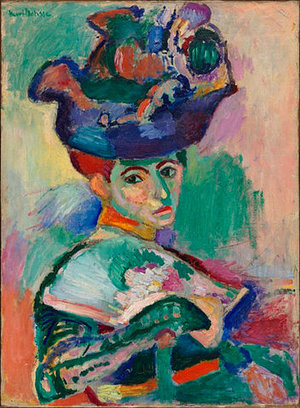
Henri Matisse, Woman with a hat, 1905, oil on canvas
Henri Matisse, Luxe, calme et volupté,1904, oil on canvas
Henri Matisse utilized a pointillist style by applying paint in small dabs and dashes. However, rather than the inconspicuous mixing of complimentary colours typical of Neo-Impressionism, for example, the blend of firey oranges, yellows, greens and purple is almost overpowering in its vibrant impact.
Henri Matisse, Bonheur de Vivre (Joy of Life), 1905-1906, oil on canvas
https://en.wahooart.com/@@/9GENHQ-Henri-Matisse-Le-bonheur-de-vivre-(The-Joy-of-Life)-
Henri Matisse has also created a famous artworks such as Bonheur de Vivre has typified this objective. This painting has a bright colour and undulating lines pull our eyes gently through the ideallic scene, it also urging us to envision feeling the warmth of the sun, the cool of the grass, the delicate touch of a caress and the passion of a kiss.
Artists of Fauvism
Maurice de Vlaminck is also one of the artists of Fauvism


Artists of Fauvism
Maurice de Vlaminck is also one of the artists of Fauvism
Maurice de Vlaminck

Maurice de Vlaminck was born in the year of 1876 in Paris. He is a French Painter. Maurice De Vlaminck is one of the Fauves at the controversial Salon d’Automne exhibition in 1905. At the age of 16, he moved to Chatou. Then, he works with fellow artists such as Andre Derain in 1900 and they successfully formed “School of Chatou”, and their painting style characterized by bright colour and bold brushstrokes which were a harbinger of Fauvism. He imitates the painting style of Vincent Van Gogh which is an expressive style to bring the expression of the emotional meaning by using bright colour in the artwork.
Fauvist Art

Maurice de Vlaminck, The Seine at Chatou,1906, oil on canvas
The Seine at Chatou is one of the artworks created by Maurice de Vlaminck in 1906 around Chatou. He was greatly influenced by Vincent Van Gogh which he imitates the painting style of Vincent Van Gogh which is an expressive style to bring the expression of the emotional meaning by using bright colour in the artwork. He using expressive style to express the emotional meaning of the artwork by combining the colors of blue and red with white. For this artwork, he applied the tube in daubs and whirls of pigment, by utilising these conventional hues for the white houses, green leaves, reddish-orange tree trunks, and the blue, red, and white trawler in the background.
References
- Keefe, J 2019, Fauvism: Definition, Art, Characteristics.Available From: https://study.com/academy/lesson/fauvism-definition-art-characteristics.html [Accessed 30 June 2019]
- Sotheby 2019, Impressionist & Modern Art: 21 Facts About Henri Matisse.Available From: https://www.sothebys.com/en/articles/21-facts-about-henri-matisse [Accessed 30 June 2019]
- Siclari, S 2019, TheArtStory: Maurice de Vlaminck Artist Overview and Analysis.Available From: https://www.theartstory.org/artist/de-vlaminck-maurice/# [ Accessed 2 August 2019]
- Met, M 2019, The Metropolitan Museum of Art: The Seine At Chatou.Available From: https://www.metmuseum.org/art/collection/search/490034 [ Accessed 2 August 2019]

Comments
Post a Comment